
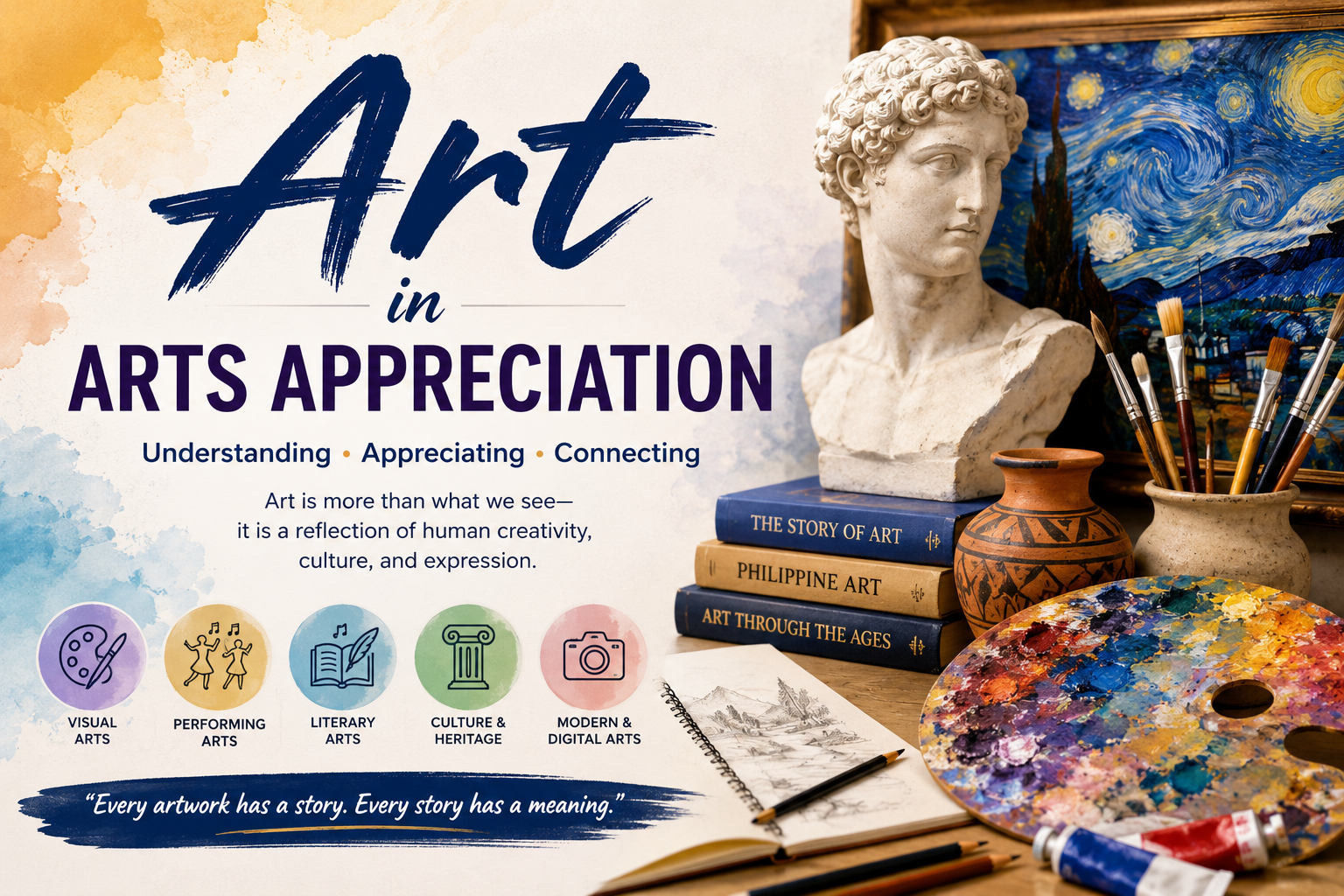
Art is one of the most meaningful ways people express thoughts, emotions, beliefs, and experiences. In Art Appreciation, students learn that art is not only about beauty or decoration. It is also about communication, culture, creativity, and understanding human life.
From paintings and sculptures to music, dance, literature, film, architecture, and digital design, art surrounds us every day. It helps people tell stories, preserve history, question society, and share ideas across generations.
Understanding art allows students to appreciate not only the finished artwork but also the message, context, and creativity behind it.
What Is Art?
Art is a human activity that uses imagination, skill, and creativity to produce something meaningful. It may be created to express emotions, communicate ideas, represent reality, entertain audiences, or reflect culture and identity.
In simple terms, art is a creative expression of human experience.
Art can be visual, auditory, literary, performing, or digital. It can be realistic or abstract, traditional or modern, simple or complex. What makes something art is not always limited to how it looks, but also what it communicates and how it affects people.
Why Art Matters in Art Appreciation
Art Appreciation helps students understand the value of art beyond personal preference. Instead of simply saying “I like it” or “I don’t like it,” students learn how to observe, analyze, interpret, and evaluate artworks.
Through Art Appreciation, learners develop the ability to ask deeper questions:
What is the artist trying to express?
What materials, techniques, or styles were used?
What emotions does the artwork create?
What cultural or historical meaning does it have?
How does it connect to society or personal experience?
These questions help students become more thoughtful and open-minded viewers of art.
The Purpose of Art
Art serves many purposes. It can be personal, social, cultural, spiritual, educational, or political. Different artists create art for different reasons, and different audiences may interpret art in different ways.
1. Art as Expression
Many artists use art to express feelings, ideas, and personal experiences. A painting, song, poem, or dance can communicate emotions that may be difficult to explain in ordinary words.
2. Art as Communication
Art can send a message. It can tell stories, raise awareness, share beliefs, or present opinions. Some artworks speak about love, identity, nature, struggle, freedom, or social issues.
3. Art as Representation
Some artworks represent people, places, events, or objects. Portraits, landscapes, historical paintings, and photographs can show how artists see the world around them.
4. Art as Cultural Identity
Art reflects the traditions, values, and beliefs of a community. Indigenous art, religious art, folk dances, traditional music, and local crafts help preserve cultural identity.
5. Art as Beauty and Enjoyment
Art can also be created for beauty, entertainment, and pleasure. People enjoy art because it can inspire, relax, excite, or move them emotionally.
Forms of Art
Art comes in many forms. Each form uses different materials, techniques, and ways of expression.
Visual Arts
Visual arts are artworks that are mainly seen. These include painting, drawing, sculpture, photography, printmaking, architecture, and digital art.
Performing Arts
Performing arts are presented through live or recorded performance. These include music, dance, theater, and performance art.
Literary Arts
Literary arts use written or spoken language creatively. These include poetry, short stories, novels, essays, drama, and spoken word.
Applied Arts
Applied arts combine beauty and function. Examples include fashion design, interior design, graphic design, product design, and decorative crafts.
Digital Arts
Digital arts use technology as a creative tool. These include digital illustration, animation, video art, web design, and multimedia production.
Elements of Art
To understand an artwork, students must also learn the basic elements of art. These are the building blocks used by artists to create visual works.
Line
A line is a mark that moves across a surface. It can be straight, curved, thick, thin, smooth, or rough. Lines can create shapes, movement, direction, and emotion.
Shape
Shape refers to a flat area with boundaries. Shapes may be geometric, like circles and squares, or organic, like natural and irregular forms.
Form
Form refers to three-dimensional objects that have height, width, and depth. Sculptures, buildings, and pottery are examples of artworks with form.
Color
Color can create mood, emphasis, and meaning. Warm colors like red and yellow may feel energetic, while cool colors like blue and green may feel calm.
Texture
Texture refers to how something feels or appears to feel. An artwork may look smooth, rough, soft, hard, shiny, or uneven.
Space
Space refers to the area around, between, or within objects. Artists use space to create depth, balance, and perspective.
Value
Value refers to the lightness or darkness of a color. It helps create contrast, depth, and dimension in an artwork.
Principles of Art
Aside from the elements, artists also use principles of art to organize their work. These include balance, contrast, emphasis, movement, rhythm, pattern, unity, and proportion.
The principles of art help explain why an artwork looks organized, powerful, harmonious, or visually interesting.
How to Appreciate Art
Appreciating art does not mean every artwork must be liked. It means making an effort to understand its meaning, purpose, and context.
Here are simple steps in appreciating art:
Observe the Artwork
Look carefully at the artwork. Notice the colors, lines, shapes, subject, materials, and overall appearance.
Describe What You See
Identify the visible details. What objects, people, places, or symbols are present?
Analyze the Elements
Think about how the artist used line, color, texture, space, and other elements to create meaning.
Interpret the Meaning
Ask what the artwork might be saying. What emotion, idea, story, or message does it communicate?
Evaluate the Artwork
Reflect on its impact. Was it effective? Did it make you think or feel something? What makes it meaningful?
The Role of the Artist
An artist is not only a person who creates beautiful things. An artist can also be a storyteller, observer, critic, designer, performer, innovator, or cultural worker.
Artists help people see the world in new ways. They can challenge beliefs, preserve traditions, inspire change, and give voice to personal or social experiences.
Art and Society
Art is closely connected to society. It reflects the time, place, and conditions in which it was created. Many artworks show the values, problems, dreams, and struggles of people.
For example, art can respond to historical events, political movements, religious beliefs, environmental concerns, and social issues. Because of this, studying art also helps students understand history, culture, and human behavior.
Why Students Should Study Art Appreciation
Studying Art Appreciation helps students develop creativity, critical thinking, cultural awareness, and emotional sensitivity. It encourages learners to become more observant and reflective.
Art Appreciation is important because it helps students:
Understand different cultures and traditions
Develop personal taste and judgment
Improve creative and critical thinking
Recognize the value of artists and artworks
Appreciate beauty, meaning, and expression in everyday life
Art teaches students that there are many ways to see, understand, and interpret the world.
Conclusion
Art is a powerful part of human life. It allows people to express emotions, communicate ideas, preserve culture, and respond to society. In Art Appreciation, students learn that art is more than an object to look at. It is a meaningful form of human expression.
By understanding the forms, elements, purposes, and context of art, students can develop a deeper appreciation for creativity and culture. Whether traditional or modern, simple or complex, art continues to shape the way people think, feel, and connect with one another.