
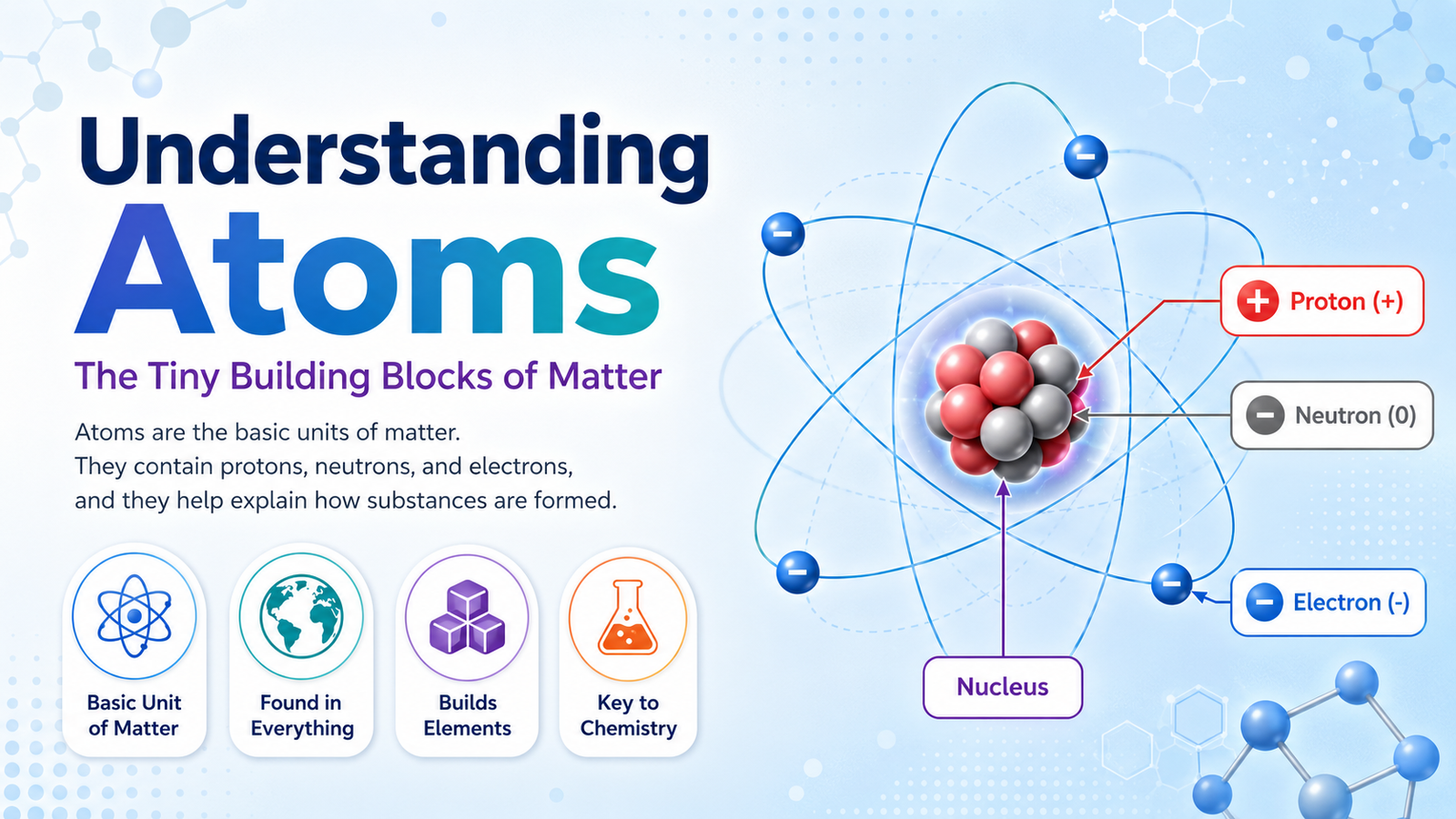
Science often explains big ideas by starting with very small things. One of the most important examples is the atom.
An atom is the smallest basic unit of matter that still has the properties of an element. Everything around us is made of atoms, including air, water, food, plants, books, and even our own bodies. Although atoms are too small to see with our eyes, they play a major role in understanding chemistry, physics, biology, and everyday life.
What Is an Atom?
An atom is a tiny particle that makes up matter. Matter is anything that has mass and takes up space. This means that most things we can touch, see, or use are made of atoms.
Atoms combine in different ways to form substances. For example, water is made of hydrogen and oxygen atoms. Salt, sugar, metal, and gases are also made from atoms arranged in specific patterns.
Parts of an Atom
Atoms are made up of three main subatomic particles:
Protons are positively charged particles found in the nucleus, or center, of the atom.
Neutrons are particles with no charge. They are also found in the nucleus.
Electrons are negatively charged particles that move around the nucleus.
The number of protons in an atom helps identify what element it is. For example, a hydrogen atom has one proton, while an oxygen atom has eight protons.
Why Atoms Matter in Science
Atoms are important because they help explain how substances behave. When students understand atoms, they can better understand chemical reactions, elements, compounds, electricity, and even how living things function.
For example, atoms can join together to form molecules. Molecules then make up many substances we use every day, such as water, oxygen, and carbon dioxide. This makes atoms a foundation for learning many science topics.
Common Student Challenges
Many students find atoms confusing because they cannot be seen directly. It can also be difficult to remember the parts of an atom and their charges.
A simple way to remember them is:
Protons = positive
Neutrons = neutral
Electrons = negative
Students may also confuse atoms with molecules. An atom is a single basic unit, while a molecule is formed when two or more atoms are joined together.
How to Study Atoms Effectively
Students can make the topic easier by using diagrams. A simple atom diagram can show the nucleus in the center with protons and neutrons inside, while electrons are shown around it.
It also helps to practice identifying the parts of an atom and answering questions about their charges, locations, and functions. Reviewing examples of elements and molecules can make the lesson more practical.
How Assemulator Can Help
Assemulator can support students by giving them a structured way to review science terms like atom, molecule, element, proton, neutron, and electron. Through online practice questions, students can test their understanding and identify which concepts need more review.
For teachers, Assemulator can help organize science review materials and provide students with a convenient platform for exam preparation.