
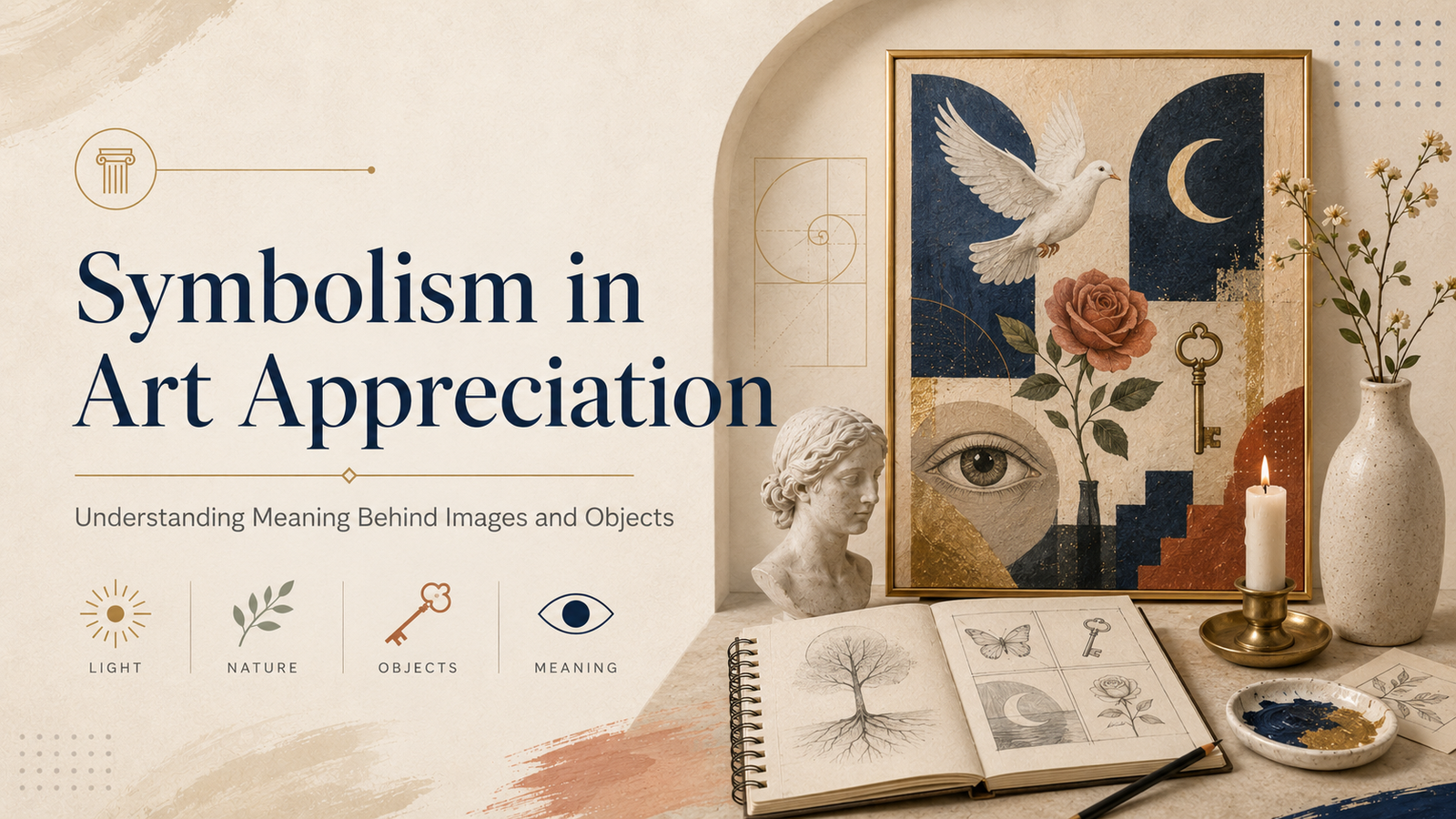
Art is not always meant to be understood only by what we see on the surface. Sometimes, an object, color, animal, gesture, or setting in an artwork represents a deeper idea. This use of meaningful signs is called symbolism.
In Art Appreciation, symbolism is important because it helps students understand how artists communicate messages beyond literal appearance. A flower may represent love, a dove may suggest peace, a dark sky may express sadness, and a broken chain may symbolize freedom.
By studying symbolism, students learn that artworks can contain hidden meanings, cultural references, personal emotions, and social messages.
What Is Symbolism in Art?
Symbolism in art refers to the use of images, objects, colors, figures, or actions to represent ideas beyond their ordinary meaning.
In simple terms, symbolism means using something visible to express something deeper.
For example, a heart is often used to symbolize love. A skull may symbolize death or danger. A lighted candle may suggest hope, memory, faith, or guidance. These symbols help artists communicate ideas in a visual and meaningful way.
Symbolism allows artworks to speak without using many words.
Why Symbolism Matters in Art Appreciation
Symbolism matters because it helps viewers interpret the message of an artwork. Without understanding symbols, students may miss important meanings that the artist intended to express.
In Art Appreciation, symbolism helps students ask deeper questions:
What objects or images appear in the artwork?
Do these objects represent something beyond themselves?
What cultural, historical, or religious meanings might they have?
How do colors, gestures, or settings add meaning?
What message is the artist trying to communicate?
These questions help students move from simple observation to meaningful interpretation.
Symbolism as a Tool for Communication
Artists often use symbolism because visual signs can communicate complex ideas quickly. Instead of directly explaining an emotion, belief, or issue, an artist may use symbols to suggest it.
For example, an artwork about hope may show sunrise, light, open doors, or growing plants. An artwork about struggle may show storms, chains, shadows, or broken objects.
Symbols can make an artwork more powerful because they invite viewers to think, feel, and interpret.
Common Symbols in Art
Many symbols are commonly used in artworks. However, their meaning may change depending on culture, context, and the artist’s intention.
1. Light
Light often symbolizes hope, truth, knowledge, guidance, or spiritual presence. A bright area in an artwork may suggest clarity, goodness, or a new beginning.
2. Darkness
Darkness may symbolize mystery, sadness, fear, danger, ignorance, or death. Artists may use dark colors or shadows to create emotional depth.
3. Flowers
Flowers can symbolize beauty, love, growth, youth, life, or fragility. Different flowers may have different meanings. For example, roses often suggest love, while lilies may suggest purity or mourning.
4. Birds
Birds often symbolize freedom, peace, spirituality, or the soul. A flying bird may suggest liberation, while a caged bird may represent restriction or oppression.
5. Water
Water may symbolize life, cleansing, renewal, change, or emotion. Calm water can suggest peace, while stormy water may suggest conflict or uncertainty.
6. Trees
Trees can symbolize life, strength, growth, family, wisdom, or connection to nature. A healthy tree may suggest stability, while a fallen tree may suggest loss or destruction.
7. Skulls
Skulls are often associated with death, mortality, danger, or the passing of time. In some cultures, skulls may also represent remembrance or respect for ancestors.
8. Chains
Chains may symbolize imprisonment, oppression, limitation, or struggle. Broken chains often represent freedom, justice, or liberation.
9. Mirrors
Mirrors can symbolize truth, self-reflection, identity, vanity, or illusion. They are often used to explore how people see themselves.
10. Colors
Colors can also be symbolic. Red may represent love, anger, passion, or danger. Blue may suggest calmness, sadness, or spirituality. White may symbolize purity, peace, or emptiness. Black may suggest mystery, power, grief, or fear.
Symbolism and Culture
Symbols are strongly connected to culture. A symbol may have one meaning in one society and a different meaning in another.
For example, white may symbolize purity in some cultures, but it may also be associated with mourning in others. Animals, colors, plants, clothing, and gestures can carry different meanings depending on cultural background.
This is why students should be careful when interpreting symbols. It is important to consider the culture, time period, religion, and social context of the artwork.
Symbolism and Religion
Many religious artworks use symbols to represent faith, spiritual ideas, and sacred stories. Halos, crosses, candles, angels, lotus flowers, sacred animals, and specific colors may carry religious meanings.
Religious symbolism helps communicate beliefs that may be difficult to express directly. It also helps viewers recognize important figures, events, and values within a faith tradition.
In Art Appreciation, studying religious symbolism helps students understand how art can serve as a form of worship, teaching, memory, and cultural identity.
Symbolism and Personal Meaning
Not all symbols are universal. Some symbols have personal meaning for the artist.
An artist may use a childhood object, family place, favorite color, or repeated image to represent memory, identity, trauma, love, or personal experience. These symbols may not be obvious at first, but they can become clearer when students learn about the artist’s background and purpose.
Personal symbolism makes art more intimate and expressive.
Symbolism and Social Issues
Artists often use symbolism to comment on society. Symbols can represent freedom, injustice, poverty, war, environmental problems, identity, migration, or inequality.
For example, a locked gate may symbolize exclusion. A cracked earth may symbolize environmental damage. A raised fist may symbolize resistance or solidarity. A mask may symbolize hidden identity or social pressure.
Through symbolism, artists can communicate powerful messages about real-life issues.
How Artists Use Symbolism
Artists can include symbolism in many parts of an artwork.
Subject Matter
The main subject of the artwork may be symbolic. A bird, tree, road, house, or human figure may represent a larger idea.
Color
Artists use color to create symbolic meaning and emotional tone.
Objects
Everyday objects can become symbols when placed in meaningful contexts.
Gestures
The pose, facial expression, or hand movement of a figure can symbolize emotion, authority, prayer, fear, or action.
Setting
The background or environment can also carry symbolic meaning. A stormy sky, empty room, crowded street, or open field may affect interpretation.
Composition
The placement of symbols in an artwork matters. A symbol at the center may be more important, while a symbol hidden in the background may invite deeper observation.
Symbolism in Different Art Forms
Symbolism appears in many forms of art, not only painting.
Symbolism in Painting
Paintings often use colors, objects, figures, and settings to communicate hidden meanings.
Symbolism in Sculpture
Sculptures may use posture, materials, form, and objects to represent strength, faith, leadership, grief, or memory.
Symbolism in Architecture
Buildings can symbolize power, spirituality, community, progress, or cultural identity. The use of height, shape, materials, and space can carry meaning.
Symbolism in Photography
Photographers use subjects, lighting, framing, and contrast to suggest meaning beyond the captured image.
Symbolism in Literature and Performing Arts
Symbols also appear in poetry, stories, theater, dance, and film. A repeated object, movement, sound, or costume can represent a deeper theme.
Symbolism in Digital Art
Digital artists use icons, visual effects, colors, and imagined worlds to express ideas about technology, identity, society, and emotion.
How to Analyze Symbolism in an Artwork
Students can analyze symbolism by following a simple process.
1. Observe the Artwork Carefully
Look at the objects, people, colors, animals, places, gestures, and details shown in the artwork.
2. Identify Possible Symbols
Ask which parts of the artwork may represent something beyond their literal meaning.
3. Consider the Context
Think about the artist, culture, time period, religion, or social issue connected to the artwork.
4. Interpret the Meaning
Ask what the symbols may suggest. Do they represent hope, fear, love, death, freedom, identity, or conflict?
5. Support Your Interpretation
Use visible details from the artwork to explain your answer. A strong interpretation should be based on evidence, not guesswork alone.
Common Mistakes When Understanding Symbolism
One common mistake is assuming that every object in an artwork is automatically symbolic. Some objects may simply be part of the scene.
Another mistake is thinking that every symbol has only one meaning. Symbols can have multiple meanings depending on context. For example, fire may symbolize destruction, passion, purification, or transformation.
Students should also avoid forcing meanings that are not supported by the artwork. Good interpretation requires observation, context, and thoughtful reasoning.
Importance of Symbolism for Students
Symbolism helps students become more careful and reflective viewers of art. It teaches them to look beyond the surface and search for deeper meaning.
Studying symbolism helps students:
Understand hidden meanings in artworks
Improve interpretation skills
Recognize cultural and historical references
Analyze colors, objects, and gestures
Appreciate personal and social messages in art
Develop critical thinking and visual literacy
These skills are useful not only in Art Appreciation but also in literature, media studies, communication, design, and everyday visual culture.
Symbolism in Everyday Life
Symbolism is not limited to artworks. It appears in daily life through logos, flags, emojis, clothing, colors, signs, and ceremonies.
A national flag can symbolize identity and unity. A wedding ring can symbolize commitment. A school logo can symbolize values and community. Even emojis use simple images to represent emotions and ideas.
By understanding symbolism, students become more aware of how visual signs shape communication.
Conclusion
Symbolism is a powerful concept in Art Appreciation. It refers to the use of visible images, objects, colors, and gestures to express deeper meanings. Through symbolism, artists communicate emotions, beliefs, cultural values, personal experiences, and social messages.
By learning how to identify and interpret symbols, students can appreciate artworks more deeply. They begin to understand that art is not only about what is seen, but also about what is suggested, remembered, felt, and understood.
Symbolism allows art to carry meaning beyond the surface, making every detail part of a larger story.