
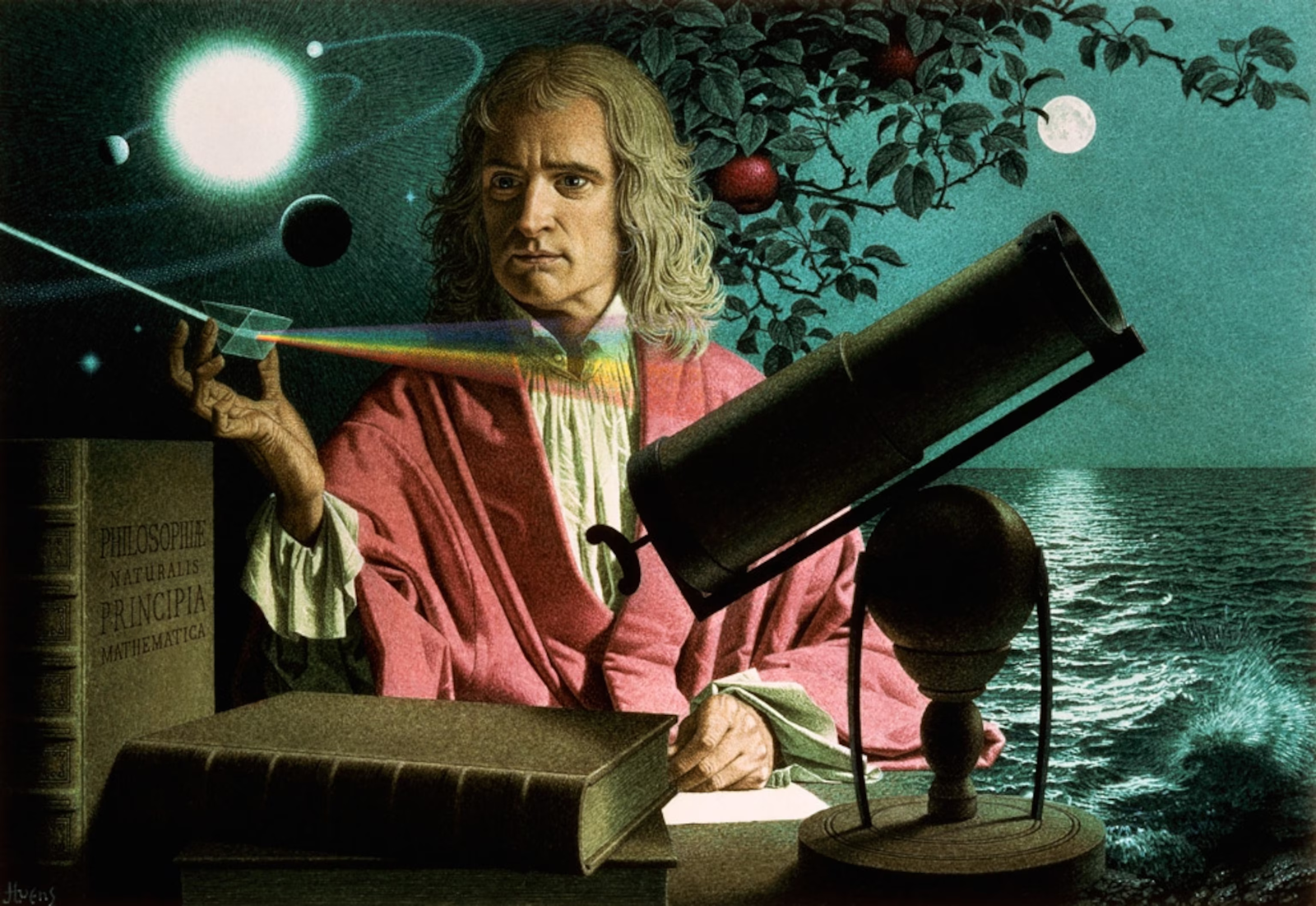
Isaac Newton is one of the most influential scientists in history. His discoveries helped people understand how objects move, why things fall, and how the universe follows certain natural laws.
For students, Newton’s life is more than a science lesson. It is a reminder that curiosity, patience, and careful observation can lead to powerful discoveries.
Who Was Isaac Newton?
Isaac Newton was born on January 4, 1643, in Woolsthorpe, England. He grew up during a time when many scientific ideas were still being explored and debated.
Newton studied at the University of Cambridge, where he developed a strong interest in mathematics, physics, astronomy, and natural philosophy. His ability to observe patterns and ask deep questions helped him become one of the key figures in the Scientific Revolution.
Newton and the Law of Gravity
Newton is most famous for his work on gravity. According to a well-known story, Newton began thinking about gravity after seeing an apple fall from a tree.
Whether the apple story happened exactly as people tell it or not, it represents an important idea: Newton wondered why objects fall downward and what force keeps the Moon moving around Earth.
His explanation became known as the law of universal gravitation. This idea showed that the same force pulling objects to the ground also affects planets, moons, and stars.
Newton’s Three Laws of Motion
Newton also developed the three laws of motion, which explain how objects move. These laws are still taught in science classes today.
The first law explains that an object will stay still or keep moving unless a force acts on it. The second law explains how force, mass, and acceleration are connected. The third law explains that for every action, there is an equal and opposite reaction.
These laws helped build the foundation of classical physics and are still useful in understanding machines, vehicles, sports, engineering, and everyday movement.
Contributions to Mathematics and Science
Newton made important contributions beyond gravity and motion. He helped develop calculus, a branch of mathematics used to study change and motion. Calculus is now essential in science, engineering, economics, and technology.
He also studied light and optics. Through experiments with prisms, Newton showed that white light is made up of different colors. This helped improve scientific understanding of light and vision.
Lessons Students Can Learn From Newton
Newton’s life offers many lessons for learners:
- Observe carefully. Simple events can lead to big questions.
- Ask why. Curiosity helps deepen understanding.
- Practice patience. Major discoveries often take time.
- Build strong foundations. Mathematics and basic concepts support advanced learning.
- Keep exploring. Learning grows when we connect ideas across subjects.
Why Newton Still Matters Today
Newton’s ideas continue to influence science, education, technology, and engineering. His laws of motion are used to explain real-world situations, from a ball rolling across the floor to rockets launching into space.
For students preparing for exams, Newton’s work is also a good example of why understanding concepts matters. Memorizing formulas can help, but knowing the meaning behind them makes learning more useful and lasting.
Conclusion
Isaac Newton changed the way people understood the natural world. His discoveries about gravity, motion, mathematics, and light shaped modern science and continue to inspire learners today.
Newton’s story reminds us that great ideas can begin with simple questions. By staying curious, thinking carefully, and studying consistently, students can develop the same spirit of discovery in their own learning journey.