
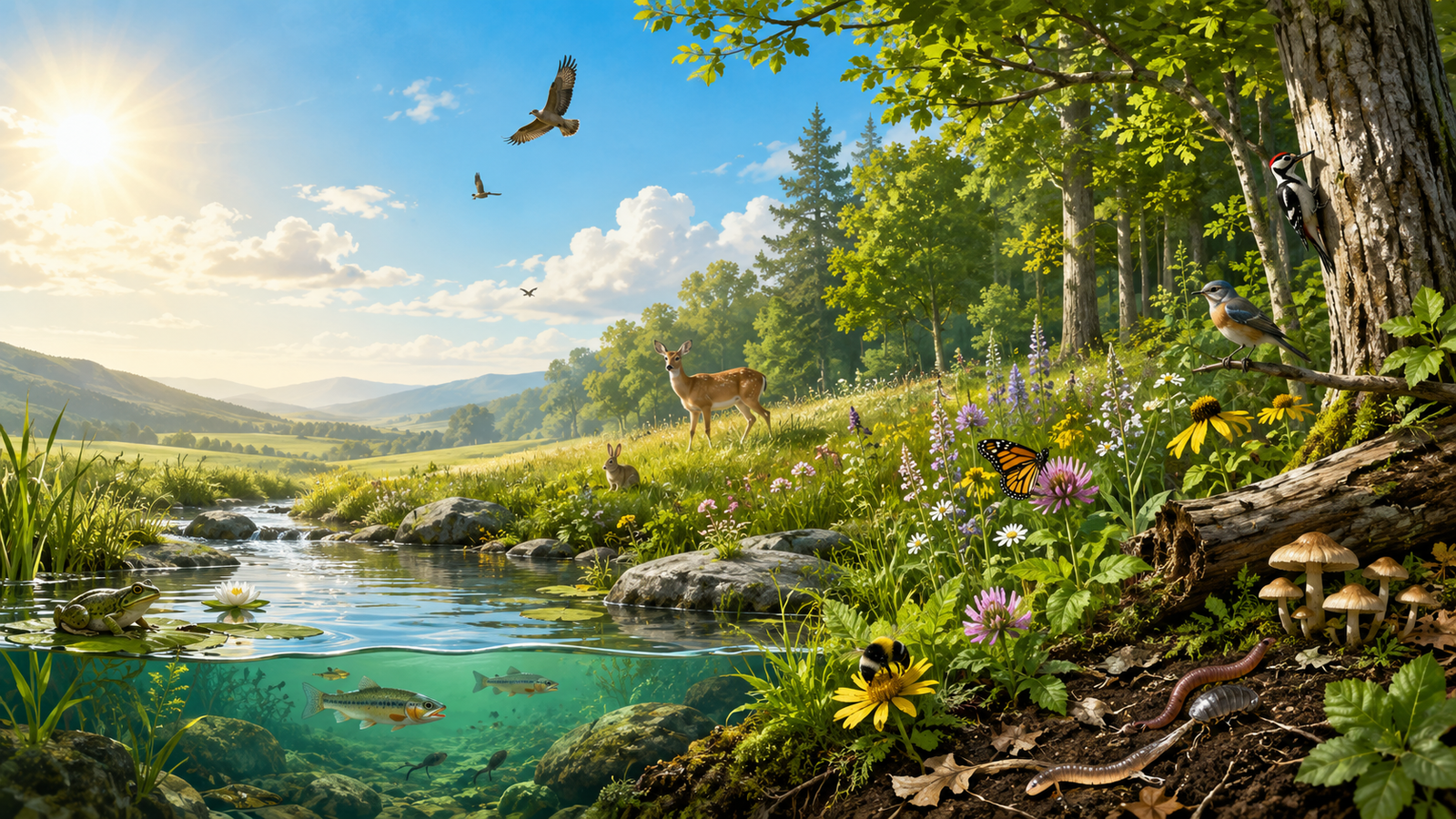
An ecosystem is a community of living things interacting with one another and with their physical environment. It includes plants, animals, microorganisms, soil, water, sunlight, air, temperature, and all the relationships that connect them.
A forest, pond, coral reef, grassland, garden, and even a rotting log can be an ecosystem. Some ecosystems are large and complex, while others are small and easy to overlook. What makes them important is not only what lives there, but how every part depends on the others.
What Is an Ecosystem?
In science, an ecosystem is made up of two main parts: biotic factors and abiotic factors.
Biotic factors are the living parts of an ecosystem. These include plants, animals, fungi, bacteria, algae, and other organisms.
Abiotic factors are the nonliving parts. These include sunlight, water, air, rocks, soil, temperature, minerals, and climate.
Together, these living and nonliving parts form a system. For example, a plant needs sunlight, water, air, and soil nutrients to grow. An insect may feed on the plant. A bird may eat the insect. When the plant or animal dies, decomposers break it down and return nutrients to the soil.
This cycle shows that an ecosystem is not just a place. It is a web of activity.
Why Ecosystems Matter
Ecosystems support life by providing food, clean water, oxygen, shelter, and natural balance. They also help recycle nutrients, regulate temperature, support pollination, and maintain healthy soil.
For humans, ecosystems are essential. Forests help produce oxygen and store carbon. Wetlands help filter water and reduce flooding. Oceans support climate regulation and provide food. Pollinators such as bees and butterflies help many plants reproduce.
When ecosystems are healthy, they support both nature and human communities.
Producers, Consumers, and Decomposers
Most ecosystems depend on the flow of energy. This energy often begins with the sun.
Producers
Producers are organisms that make their own food. Plants, algae, and some bacteria are producers. They use sunlight to produce food through photosynthesis.
Producers form the base of many food chains because they provide energy for other organisms.
Consumers
Consumers are organisms that get energy by eating other organisms.
Herbivores eat plants.
Carnivores eat animals.
Omnivores eat both plants and animals.
For example, in a grassland ecosystem, grass is a producer, a grasshopper is a herbivore, a frog may eat the grasshopper, and a snake may eat the frog.
Decomposers
Decomposers break down dead plants, animals, and waste materials. Fungi, bacteria, and some insects are decomposers.
They play a quiet but powerful role. Without decomposers, nutrients would remain locked inside dead matter. Decomposers return those nutrients to the soil, helping new life grow.
Food Chains and Food Webs
A food chain shows how energy moves from one organism to another. It is usually shown in a simple line.
For example:
Grass → Grasshopper → Frog → Snake → Hawk
However, real ecosystems are more complex. Most organisms eat more than one type of food, and many are eaten by more than one predator. This creates a food web.
A food web is a network of connected food chains. It gives a more realistic picture of how energy moves through an ecosystem.
Balance in an Ecosystem
Ecosystems depend on balance. If one part changes, other parts can be affected.
For example, if the number of predators decreases, the population of prey may increase. If too many plants are eaten, there may be less food and shelter for other organisms. If water becomes polluted, fish, insects, birds, and humans may all be affected.
Balance does not mean nothing changes. Ecosystems naturally change over time because of seasons, weather, migration, growth, death, and reproduction. A healthy ecosystem can adjust to many changes, but extreme or sudden changes can cause damage.
Types of Ecosystems
There are many kinds of ecosystems, but they are often grouped into two main types: terrestrial ecosystems and aquatic ecosystems.
Terrestrial Ecosystems
Terrestrial ecosystems are found on land. Examples include forests, grasslands, deserts, tundra, and mountains.
A forest ecosystem may include trees, birds, insects, mammals, fungi, soil, sunlight, and rainfall. A desert ecosystem may have fewer plants and animals, but the organisms there are specially adapted to dry conditions.
Aquatic Ecosystems
Aquatic ecosystems are found in water. They include freshwater ecosystems, such as rivers, lakes, and ponds, and marine ecosystems, such as oceans, coral reefs, and estuaries.
Aquatic ecosystems support many forms of life, from microscopic plankton to large marine animals.
Human Impact on Ecosystems
Human activities can affect ecosystems in both positive and negative ways.
Pollution, deforestation, overfishing, habitat destruction, invasive species, and climate change can disturb ecosystems. These changes may reduce biodiversity, damage food webs, and make it harder for organisms to survive.
However, people can also help protect ecosystems. Reforestation, proper waste management, conservation programs, sustainable farming, responsible fishing, and habitat restoration can support healthier environments.
Small actions matter too. Planting native plants, reducing plastic use, conserving water, and protecting local green spaces can help ecosystems in everyday life.
Biodiversity and Ecosystem Health
Biodiversity means the variety of life in an area. An ecosystem with high biodiversity usually has many different species of plants, animals, fungi, and microorganisms.
Biodiversity helps ecosystems stay strong. If one species becomes less common, another species may help fill its role. This makes the ecosystem more stable and better able to recover from changes.
A diverse ecosystem is like a team with many skilled members. Each organism contributes something to the system.
Why Students Should Learn About Ecosystems
Learning about ecosystems helps students understand how life is connected. It shows that organisms do not live alone; they depend on one another and on their environment.
Ecosystems also connect biology, earth science, environmental science, agriculture, and human health. By studying ecosystems, students learn why clean water, healthy soil, biodiversity, and conservation are important.
Understanding ecosystems encourages better choices, not only in the classroom but also in daily life.
Final Thoughts
An ecosystem is more than a collection of plants and animals. It is a living network where energy flows, nutrients cycle, and organisms depend on each other to survive. From the smallest bacteria in the soil to the tallest tree in a forest, every part has a role.
The next time you see a pond, garden, forest, or patch of grass, remember that it is full of hidden connections. An ecosystem teaches us one of science’s most important lessons: life works best when its parts are connected, balanced, and cared for.