
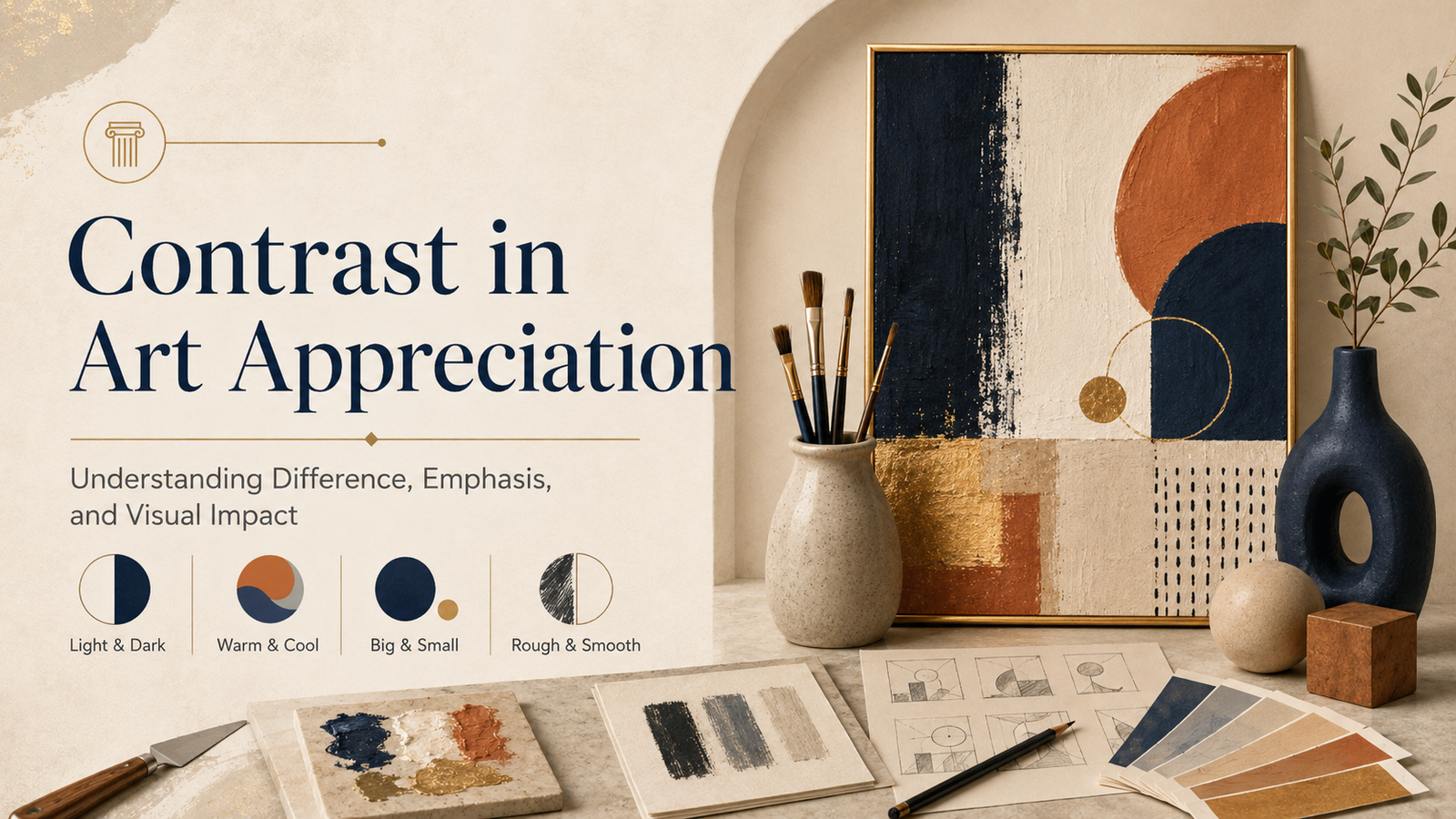
In art, differences can make an artwork stronger. A bright color beside a dark color, a rough texture beside a smooth surface, or a small figure beside a large background can immediately catch the viewer’s attention. This use of difference is called contrast.
In Art Appreciation, contrast is one of the most important principles of design because it helps create emphasis, variety, drama, and meaning. It guides the viewer’s eyes and makes certain parts of an artwork stand out.
Contrast is not only about making an artwork look attractive. It is also a way for artists to communicate ideas, emotions, and relationships between visual elements.
What Is Contrast in Art?
Contrast refers to the use of opposite or noticeably different elements in an artwork. These differences may appear in color, value, size, shape, texture, direction, form, or subject matter.
In simple terms, contrast means placing differences together to create visual interest or meaning.
For example, an artist may place light beside dark, warm colors beside cool colors, large shapes beside small shapes, or soft lines beside sharp lines. These differences make the artwork more dynamic and help viewers notice important details.
Why Contrast Matters in Art Appreciation
Contrast matters because it helps viewers understand how an artwork is organized and what the artist wants to emphasize. Without contrast, an artwork may look flat, dull, or difficult to read. With effective contrast, an artwork can become clear, expressive, and visually engaging.
In Art Appreciation, studying contrast helps students answer questions such as:
What part of the artwork stands out the most?
How does the artist create emphasis?
What differences are used in the artwork?
How does contrast affect mood or meaning?
Why did the artist place opposite elements together?
By recognizing contrast, students can better understand how artists create impact and communicate ideas.
Contrast as a Principle of Design
Contrast is one of the principles of design, which artists use to organize the elements of art. It works closely with other principles such as emphasis, balance, unity, variety, and movement.
Contrast can create a focal point, or the area that attracts the most attention. It can also prevent an artwork from becoming too repetitive or predictable.
However, contrast must be used thoughtfully. Too little contrast may make an artwork feel weak, while too much contrast may make it feel confusing or overwhelming. Good contrast supports the overall purpose of the artwork.
Types of Contrast in Art
Artists can create contrast in many ways. Each type affects how viewers see and feel the artwork.
1. Contrast in Value
Value refers to the lightness or darkness of a color. Value contrast happens when light and dark areas are placed together.
A white object against a black background creates strong value contrast. This can make the object stand out clearly. Artists often use value contrast to create depth, drama, and focus.
High value contrast can feel bold, serious, or intense. Low value contrast can feel soft, calm, or subtle.
2. Contrast in Color
Color contrast happens when different colors are placed together. This may include warm and cool colors, complementary colors, bright and dull colors, or light and dark colors.
For example, red beside green, blue beside orange, or yellow beside purple creates strong visual energy because these are complementary color pairs. Warm colors like red, orange, and yellow can appear active, while cool colors like blue, green, and violet may feel calm or distant.
Color contrast can affect mood, symbolism, and emotional response.
3. Contrast in Size
Size contrast occurs when large and small elements are placed together. A tiny figure in front of a huge building can suggest power, distance, loneliness, or scale.
Artists use size contrast to show importance, create depth, or make a subject more dramatic. Larger objects often attract attention first, while smaller objects may add detail or meaning.
4. Contrast in Shape
Shape contrast happens when different kinds of shapes appear together. Geometric shapes, such as squares and circles, can contrast with organic shapes, such as leaves, clouds, or human forms.
This type of contrast can create variety and visual interest. It may also suggest the difference between structure and nature, order and freedom, or stability and movement.
5. Contrast in Texture
Texture refers to how a surface feels or appears to feel. Texture contrast occurs when rough and smooth, soft and hard, or shiny and dull surfaces are placed together.
For example, a smooth glass object beside rough wood creates texture contrast. In painting, artists may show texture visually through brushstrokes, patterns, or shading. Texture contrast can make an artwork feel more realistic and engaging.
6. Contrast in Line
Lines can be straight, curved, thick, thin, sharp, soft, horizontal, vertical, or diagonal. Line contrast happens when different types of lines are used together.
Straight lines may feel stable and controlled, while curved lines may feel graceful or natural. Thick lines may appear strong, while thin lines may appear delicate. Diagonal lines may suggest movement, while horizontal lines may suggest calmness.
Line contrast helps create rhythm, direction, and expression.
7. Contrast in Form
Form refers to three-dimensional objects or the illusion of three-dimensionality. Form contrast can occur when different forms are combined, such as round forms beside angular forms or solid forms beside open spaces.
In sculpture and architecture, form contrast can create balance, tension, and visual interest. It helps viewers experience the artwork from different angles.
8. Contrast in Space
Space contrast involves differences between positive space and negative space. Positive space refers to the main subjects, while negative space refers to the empty or surrounding areas.
A small subject surrounded by a large empty space can create strong emotional impact. It may suggest isolation, peace, silence, or importance depending on the context.
9. Contrast in Subject Matter
Artists may also create contrast through ideas or themes. For example, an artwork may show youth and old age, wealth and poverty, peace and conflict, tradition and modernity, or nature and technology.
This kind of contrast can make the artwork more meaningful because it encourages viewers to compare ideas and think more deeply.
Contrast and Emphasis
Contrast is one of the most effective ways to create emphasis. When one part of an artwork is different from the rest, the viewer naturally pays attention to it.
For example, if most of an artwork uses dull colors but one area uses bright red, that red area becomes a focal point. If most shapes are small but one shape is large, the large shape becomes important.
This is why contrast helps artists guide attention and communicate what matters most in the artwork.
Contrast and Mood
Contrast can strongly affect the mood of an artwork. Strong contrast may create drama, excitement, tension, or seriousness. Soft contrast may create calmness, gentleness, mystery, or harmony.
For example, black-and-white contrast can feel powerful and direct. Warm-and-cool contrast can create emotional depth. Rough-and-smooth contrast can make an artwork feel active or textured.
By changing the level of contrast, artists can change how viewers emotionally respond to the work.
Contrast and Meaning
Contrast can also create meaning. Artists often use visual differences to show conflict, comparison, transformation, or connection.
A bright figure in a dark environment may suggest hope. A small person beside a large object may suggest weakness or wonder. A modern building beside an old structure may suggest change, progress, or tension between past and present.
In this way, contrast becomes more than a design technique. It becomes a storytelling tool.
Examples of Contrast in Everyday Visuals
Contrast appears not only in fine art but also in everyday design. Posters use contrast to make text readable. Websites use contrast to highlight buttons and important information. Photographs use contrast to create mood. Fashion uses contrast through color, texture, and pattern.
Students can observe contrast in:
School posters
Book covers
Advertisements
Photography
Architecture
Clothing design
Product packaging
Digital interfaces
Films and videos
Recognizing contrast in daily life helps students become more visually aware.
How to Analyze Contrast in an Artwork
Students can analyze contrast by looking carefully at the differences within an artwork.
Step 1: Identify What Stands Out
Look for the first area that catches your attention. Ask what makes it different from the rest of the artwork.
Step 2: Observe the Elements
Notice whether the contrast is created through color, value, size, shape, texture, line, form, or space.
Step 3: Consider the Effect
Ask how the contrast affects the mood of the artwork. Does it create excitement, calmness, tension, mystery, or drama?
Step 4: Interpret the Meaning
Think about why the artist used contrast. Does it show importance, conflict, comparison, or emotion?
Step 5: Evaluate the Artwork
Decide whether the contrast supports the overall message and composition. Effective contrast should strengthen the artwork, not distract from it.
Common Mistakes When Understanding Contrast
Some students think contrast only means black and white. While black-and-white contrast is common, contrast can appear in many forms, including size, texture, shape, color, and ideas.
Another mistake is thinking that more contrast is always better. Strong contrast can be effective, but it must fit the purpose of the artwork. Sometimes subtle contrast creates a more thoughtful or peaceful effect.
Importance of Contrast for Students
Studying contrast helps students become better observers and interpreters of art. It teaches them to notice relationships between visual elements and understand how artists create impact.
Contrast helps students:
Recognize focal points
Understand visual differences
Analyze mood and meaning
Identify design choices
Appreciate artistic expression
Apply visual awareness in daily life
These skills are useful not only in Art Appreciation but also in photography, design, media, presentations, and communication.
Conclusion
Contrast is a powerful principle in Art Appreciation. It refers to the use of differences to create emphasis, variety, mood, and meaning. Artists use contrast through value, color, size, shape, texture, line, form, space, and subject matter.
By understanding contrast, students can better appreciate how artworks capture attention and communicate ideas. Contrast helps transform an artwork from a simple arrangement of elements into a meaningful visual experience.
Whether bold or subtle, contrast gives art energy, clarity, and emotional depth.