
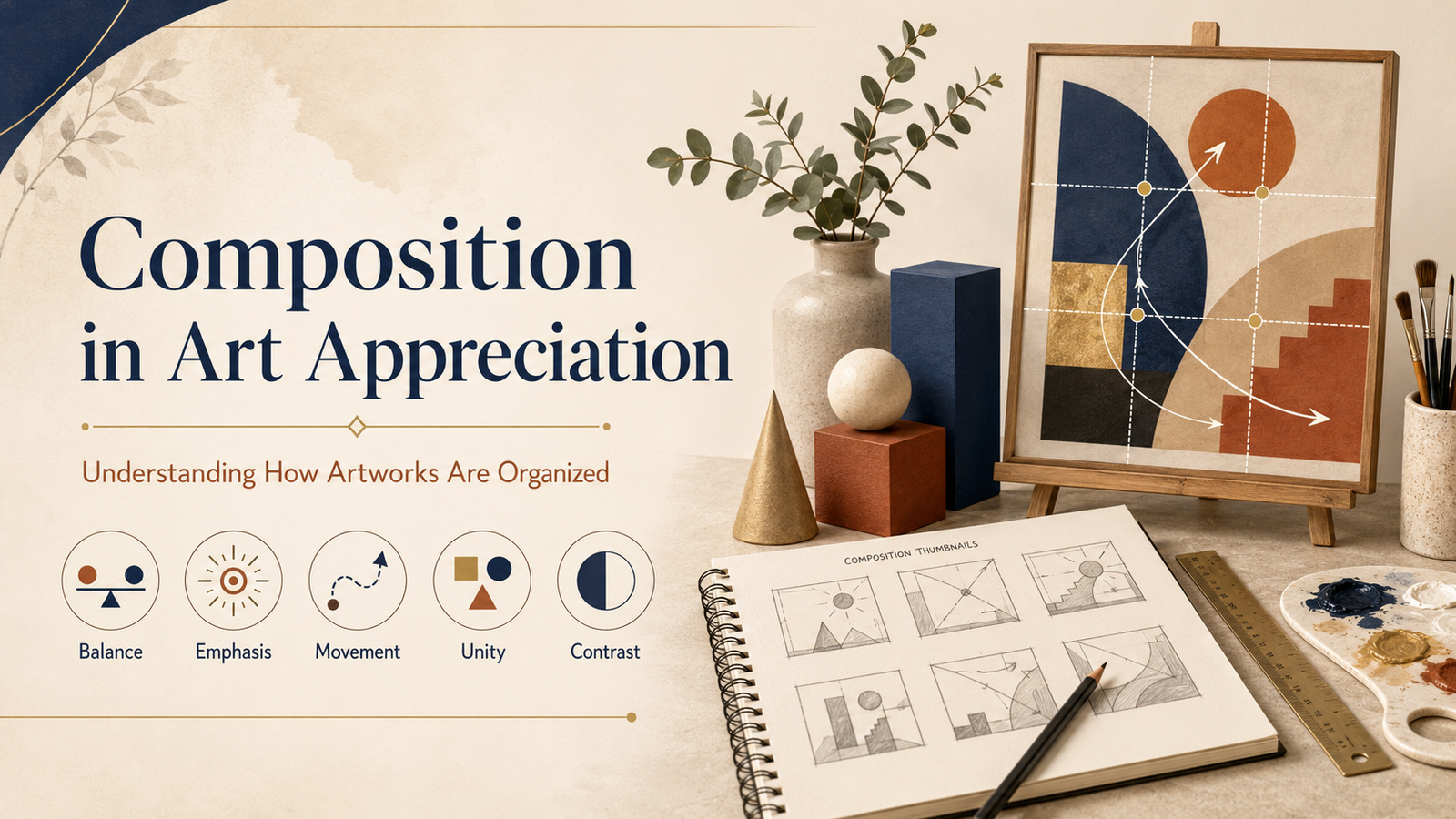
When we look at an artwork, our eyes do not move randomly. We notice certain parts first, follow visual directions, and respond to the overall arrangement of colors, shapes, lines, and forms. This arrangement is called composition.
In Art Appreciation, composition is an important concept because it helps students understand how artists organize visual elements to create meaning, beauty, harmony, tension, or emotional impact. A strong composition can guide the viewer’s attention and make an artwork more effective.
Composition is not only about placing objects in a picture. It is about making thoughtful choices so every part of the artwork contributes to the whole.
What Is Composition in Art?
Composition refers to the arrangement or organization of visual elements within an artwork. These elements may include line, shape, color, texture, space, form, and value.
In simple terms, composition is how the parts of an artwork are put together.
Artists use composition to decide where objects should be placed, what should stand out, how the viewer’s eye should move, and how the artwork should feel. Whether the artwork is a painting, photograph, sculpture, poster, digital design, or architectural work, composition affects how people understand and experience it.
Why Composition Matters in Art Appreciation
Composition matters because it helps create order, focus, and meaning. Without composition, an artwork may feel confusing, unbalanced, or unfinished. With careful composition, even a simple subject can become visually powerful.
In Art Appreciation, studying composition helps students answer important questions:
What part of the artwork attracts attention first?
How does the artist guide the viewer’s eyes?
Is the artwork balanced or intentionally unstable?
How do the visual elements work together?
What feeling or message does the arrangement create?
By learning composition, students become better at observing and analyzing artworks.
Elements Used in Composition
Artists use the elements of art as building blocks of composition. These elements help shape how the artwork looks and feels.
Line
Lines can guide the viewer’s eyes across an artwork. They may create direction, movement, structure, or emotion. Diagonal lines often suggest action, while horizontal lines may create calmness.
Shape
Shapes help organize space and create visual interest. Geometric shapes can feel stable and structured, while organic shapes can feel natural and free-flowing.
Color
Color affects mood, emphasis, and harmony. Bright colors can attract attention, while muted colors may create calm or seriousness.
Texture
Texture adds visual or physical quality to an artwork. It can make a surface appear rough, smooth, soft, hard, or layered.
Space
Space refers to the area around, between, and within objects. Artists use space to create depth, distance, openness, or crowding.
Value
Value refers to the lightness or darkness of tones. It helps create contrast, depth, and focus.
Form
Form gives objects a three-dimensional quality. In sculpture, architecture, and realistic drawing, form helps create volume and structure.
Principles of Design in Composition
The principles of design help artists arrange the elements of art effectively. These principles are essential in understanding composition.
Balance
Balance refers to the distribution of visual weight in an artwork. An artwork may have symmetrical balance, asymmetrical balance, or radial balance.
Symmetrical balance creates a formal and stable appearance. Asymmetrical balance creates interest by using different elements that still feel visually balanced. Radial balance arranges elements around a central point.
Emphasis
Emphasis is the area of an artwork that attracts the most attention. This is also called the focal point. Artists create emphasis through contrast, color, size, placement, or detail.
A clear focal point helps viewers know where to look first.
Contrast
Contrast happens when opposite elements are placed together, such as light and dark, large and small, smooth and rough, or warm and cool colors. Contrast creates visual interest and can highlight important parts of the artwork.
Movement
Movement refers to how the viewer’s eye travels through an artwork. Artists can create movement using lines, shapes, repetition, direction, or rhythm.
Good movement keeps the viewer engaged and helps connect different parts of the artwork.
Rhythm
Rhythm is created through repetition or pattern. Repeated lines, shapes, colors, or forms can create a sense of flow, beat, or visual movement.
Unity
Unity means that the parts of an artwork work together as a whole. Even if an artwork has many details, unity makes it feel complete and connected.
Variety
Variety adds interest by including differences in color, shape, size, texture, or direction. Without variety, an artwork may feel too plain or predictable.
Proportion
Proportion refers to the size relationship between parts of an artwork. Correct or intentional proportion can affect realism, symbolism, or emotional effect.
Common Types of Composition
Artists use different compositional approaches depending on their purpose and style.
Centered Composition
In a centered composition, the main subject is placed near the middle of the artwork. This creates direct focus and stability.
Rule of Thirds
The rule of thirds divides an image into nine equal parts using two horizontal and two vertical lines. Placing important elements along these lines or intersections can create a more dynamic composition.
Diagonal Composition
Diagonal composition uses diagonal lines or arrangements to create movement, tension, or energy. It is often used in action scenes and dramatic artworks.
Symmetrical Composition
Symmetrical composition places similar elements on both sides of an artwork. This creates balance, order, and formality.
Asymmetrical Composition
Asymmetrical composition uses unequal elements that still feel balanced. This can make an artwork look more natural, modern, or visually interesting.
Radial Composition
Radial composition arranges elements around a central point. It is often seen in mandalas, rose windows, circular designs, and some architectural layouts.
Open Composition
Open composition suggests that the artwork continues beyond the frame. It can make a scene feel natural, active, or incomplete in an intentional way.
Closed Composition
Closed composition keeps all important elements within the frame. This creates a complete and contained feeling.
Composition in Different Art Forms
Composition is not limited to painting. It appears in many forms of art and design.
Composition in Painting and Drawing
In painting and drawing, composition determines how subjects, background, colors, and details are arranged. Artists use composition to create focus, depth, and visual flow.
Composition in Photography
Photographers use composition to frame subjects, control lighting, guide attention, and capture meaningful moments. Camera angle, cropping, and spacing are important compositional choices.
Composition in Sculpture
In sculpture, composition involves form, volume, balance, and space. Viewers may experience the artwork from different angles, so the arrangement must work in three dimensions.
Composition in Architecture
Architecture uses composition through structure, proportion, symmetry, rhythm, and spatial organization. Buildings are designed not only for function but also for visual experience.
Composition in Digital Art and Design
In digital art, posters, websites, and graphics, composition helps arrange text, images, colors, and icons clearly. A strong layout makes information easier to understand.
How Composition Creates Meaning
Composition can influence how viewers interpret an artwork. For example, a small figure placed in a large empty space may suggest loneliness or isolation. A crowded composition may suggest chaos, energy, or celebration. A balanced composition may feel peaceful, while an off-center composition may feel tense or dynamic.
Artists use arrangement to support the message of the artwork. The placement of subjects, use of space, contrast, and direction can all contribute to meaning.
This is why composition is not just a technical skill. It is also a tool for communication.
How to Analyze Composition in an Artwork
Students can analyze composition by asking simple guide questions:
What is the focal point?
Identify the part of the artwork that attracts attention first. Ask how the artist made it stand out.
How is balance created?
Look at how visual weight is distributed. Is the composition symmetrical, asymmetrical, or radial?
How does the eye move?
Notice the lines, shapes, colors, or patterns that guide your attention across the artwork.
How is space used?
Observe whether the artwork feels open, crowded, deep, flat, calm, or active.
What creates unity?
Look at repeated colors, shapes, lines, or themes that connect different parts of the artwork.
What mood does the composition create?
Think about whether the arrangement feels peaceful, tense, dramatic, joyful, formal, or mysterious.
Tips for Students Learning Composition
Composition becomes easier to understand with practice. Students can improve their appreciation by observing artworks carefully and comparing different arrangements.
A useful activity is to look at a painting, photograph, or poster and identify the focal point, balance, contrast, and movement. Students can also sketch simple layouts to see how changing the placement of objects affects meaning.
By practicing composition analysis, students learn to see art more thoughtfully.
Importance of Composition in Art Appreciation
Composition helps students understand how artworks are created and why they are visually effective. It teaches that art is not only about the subject but also about arrangement, structure, and design choices.
Studying composition helps learners:
Understand how artists organize visual elements
Identify focal points and visual movement
Analyze balance, contrast, rhythm, and unity
Interpret meaning through arrangement
Appreciate different styles and art forms
Apply design thinking in everyday visual experiences
These skills are useful not only in Art Appreciation but also in photography, design, media, communication, and creative projects.
Conclusion
Composition is one of the most important concepts in Art Appreciation. It refers to how the elements of art are arranged to create focus, balance, movement, unity, and meaning.
A strong composition helps guide the viewer’s eyes and strengthens the message of the artwork. By understanding composition, students can better appreciate how artists make visual choices that affect emotion, interpretation, and overall impact.
Whether in painting, photography, sculpture, architecture, or digital design, composition helps transform separate parts into a meaningful whole.